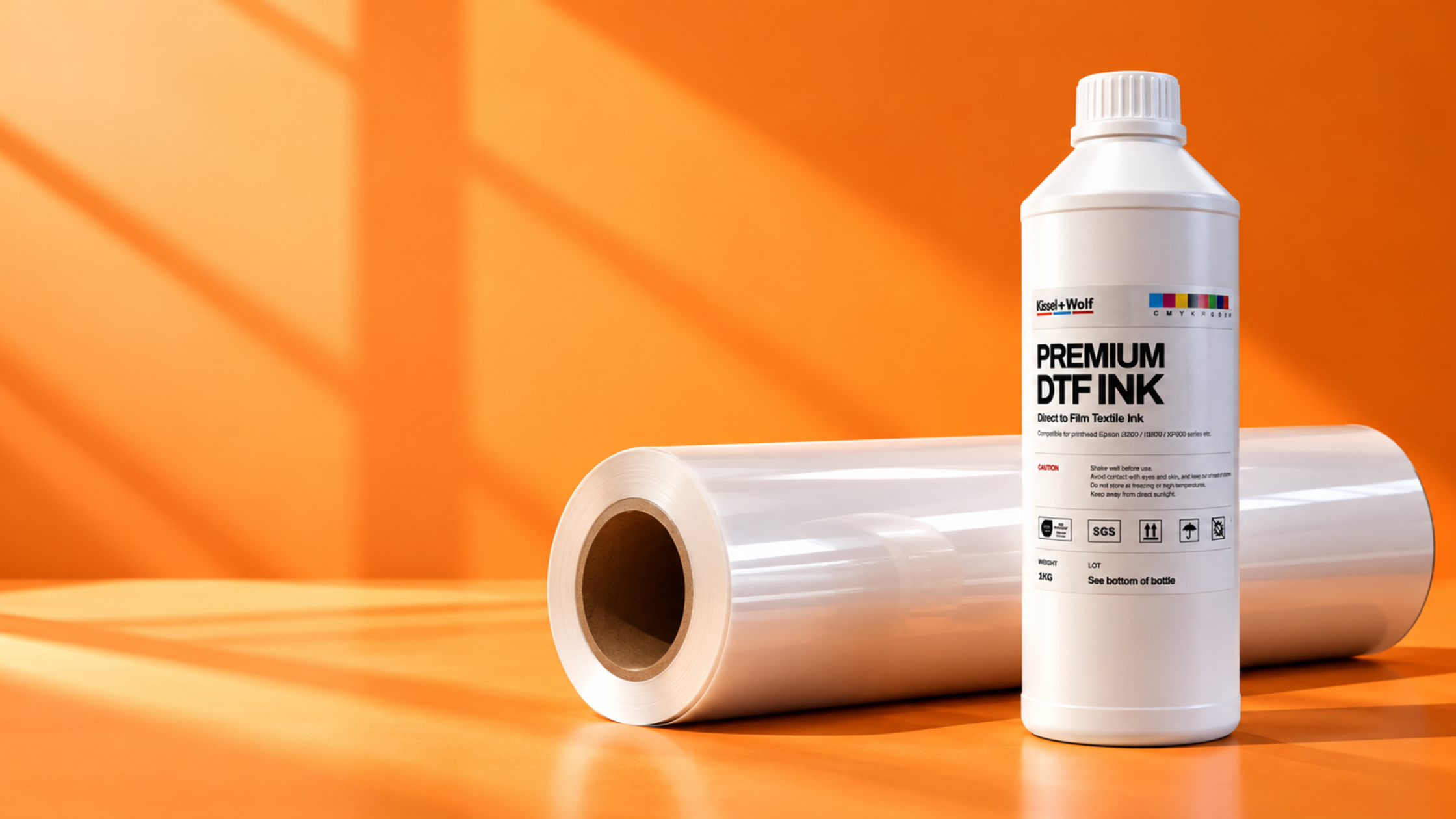
Most DTF printers run five colours: cyan, magenta, yellow, black and white. K+W Premium DTF Ink comes in thirteen. That isn't thirteen for the sake of a bigger number. Each extra colour fixes a specific problem that a five-colour set can't.
The full set is CMYK, plus red, green, blue and orange, plus white, plus four light inks: light cyan (LC), light magenta (LM), light black (LK) and light light black (LLK). Here's what each group actually does once it's on a garment, and how to tell whether your printer can use it.
The three-step black: K, LK and LLK
With black ink alone, a printer makes grey by spacing black dots further apart. On a smooth gradient or a pale grey, those sparse dots show up as grain. On cotton, which already has its own texture, the grain looks even worse.
Light black and light light black are diluted versions of the same black. The printer can lay down more dots of a lighter ink instead of a few dots of a dark one. The result is smooth greys, soft shadows and gradients that fade out instead of breaking up.
There's a second benefit. A five-colour printer often builds greys by mixing cyan, magenta and yellow, and those mixed greys can drift warm or cool from print to print. Greys built from black inks stay neutral. That matters for monochrome photography, charcoal and heather designs, and any brand artwork with a grey in it.
Light cyan and light magenta: smoother highlights
LC and LM work the same way as the light blacks, but for colour. Pale blues, pinks, pastels and highlights are where a CMYK set shows its dots most, because there's so little ink on the page.
The most noticeable difference is in skin tones. Faces printed with full-strength cyan and magenta alone can look blotchy or slightly mottled. With the light inks filling in, they look like skin. The same goes for skies, soft-focus backgrounds and any artwork with a gentle fade.
Red, green, blue and orange: colours CMYK can't reach
CMYK mixes most colours well, but some sit outside what it can reproduce. Bright reds, vivid greens, deep royal blues and strong oranges often come out flat or slightly muddy, because the printer is building them from inks that aren't quite the right shade.
Dedicated red, green, blue and orange inks widen that range, which printers call the gamut. For club and school sportswear, team colours and brand logos, that's often the difference between a print the customer accepts and one they send back. If you regularly get asked to match a specific red or a corporate blue, these four channels are doing most of the work.
The white: the layer everything else stands on
White does more than print white areas. In DTF, the printer lays the colour onto the film first and then prints a white layer over the top. The adhesive powder sticks to that white layer. Once the transfer is pressed, the white sits between the garment and the colour.
That makes it the opaque base that keeps colours bright on dark garments. If the white goes down thin, the garment shows through. Colours look dull, and solid whites turn grey. It's also part of how the transfer bonds, so a weak white layer can mean weaker adhesion and earlier wear.
White ink is heavy with pigment, and that pigment settles. Shake bottles well before every top-up. Keep the white circulating if your printer supports it, and run it regularly rather than letting it sit. Store all K+W Premium DTF Ink away from freezing temperatures, high heat and direct sunlight. A good white that has been left to settle prints like a bad one.
Do you need all 13?
Probably not all at once. Which inks you can use depends on how many channels your printer has and how its RIP software is set up. A standard five-channel machine runs CMYK and white. Printers with more channels can add the light inks, the extended colours, or both.
The set is built for printers using Epson i3200, i1600 and XP600 printheads, including the AGP DTF range we supply. If you're not sure how your printer is configured, or whether adding channels is worth it for the work you do, ask us. We'll tell you which inks will make a visible difference on your jobs, and which won't.
Print. Powder. Press. All from one supplier.
Ink is only one part of a good transfer. K+W now supplies the whole workflow: the AGP DTF printer, Premium DTF Ink, Premium DTF Film — Synthetic and Natural Textiles, and the OtterPro heat presses that finish the job. Everything is stocked locally, and it's backed by a technical team that already knows your printer.
Frequently Asked Questions
Can I mix K+W ink with the ink already in my printer?
We don't recommend mixing brands in the same channel. When you switch, flush the lines first so the new ink runs clean from the start. Our team can talk you through it for your printer.
Is the ink certified?
Yes. Kissel+Wolf’s Premium DTF Ink is ECO PASSPORT and SGS certified, and it comes in 1 kg bottles.